
 Facebook
 X
 Pinterest
 Copy Link
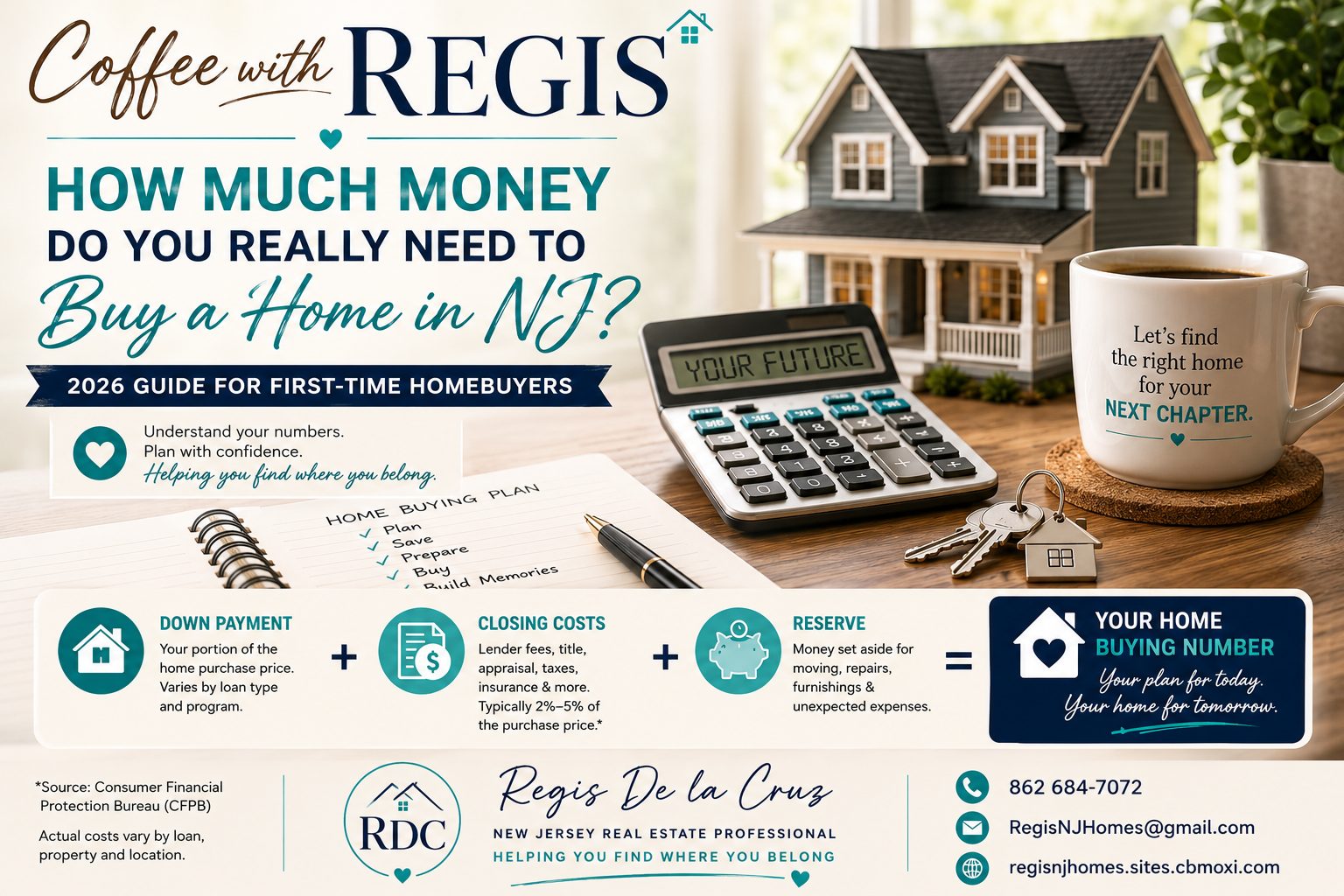
☕ Coffee with Regis
Imagine we’re sitting together at a local coffee shop.
You ask…
“Regis, how much money do I actually need to buy a house in New Jersey?”
This is one of the most important questions you can ask before you start looking at homes.
And here’s the good news:
You may need less for your down payment than you think.
But there’s also something many first-time buyers don’t realize:
Your down payment isn’t the only money you’ll need.
When you’re planning to buy a home in New Jersey, you should think about four main buckets of money:
- Your down payment
- Closing costs
- Upfront expenses before closing
- Money you keep in reserve after you buy
Let’s break them down in simple terms.
1. Do You Really Need 20% Down?
No.
You do not necessarily need a 20% down payment to buy a home.
Depending on your qualifications and the type of mortgage you choose, you may have access to lower-down-payment options.
These can include:
- Conventional mortgages
- FHA-insured mortgages
- VA loans for eligible borrowers
- USDA loans for eligible borrowers and properties
- NJHMFA mortgage and assistance programs
Putting less than 20% down can affect mortgage insurance, monthly payments, and other loan costs, so it’s important to compare the complete picture with your lender.
☕ Regis’ Buyer Tip
Don’t ask your lender only:
“What’s the minimum I can put down?”
Instead ask:
“Can you show me what my payment and total cash needed would look like with different down payments?”
Sometimes putting a little more or a little less down can significantly change your overall financial picture.
2. What Are Closing Costs?
Closing costs are expenses associated with getting your mortgage and completing the purchase of your home.
They are separate from your down payment.
According to the Consumer Financial Protection Bureau, closing costs typically range from approximately 2% to 5% of the home’s purchase price, excluding your down payment.
Your actual costs can be higher or lower depending on your mortgage, lender, property, location and transaction.
Closing costs may include items such as:
- Lender fees
- Appraisal
- Title-related costs
- Government and recording fees
- Attorney-related expenses
- Prepaid interest
- Homeowners insurance
- Initial escrow deposits for taxes and insurance
Your lender will provide a Loan Estimate showing estimated loan terms, monthly payments, closing costs and estimated cash needed to close.
3. What Does “Cash to Close” Mean?
This is a phrase every first-time buyer should understand.
Cash to close is the estimated amount you’ll actually need to bring to your closing.
It isn’t necessarily the same as your down payment.
Your cash to close can include your:
Down payment + closing costs + certain prepaid expenses and adjustments − applicable deposits, credits or assistance.
Your lender’s Loan Estimate provides an estimated Cash to Close figure.
☕ Example
Imagine you’re buying a home for:
$500,000
If your mortgage requires a 5% down payment:
Down payment: $25,000
Now suppose, strictly for illustration, that your closing costs equal 3%:
Estimated closing costs: $15,000
Your simple starting estimate would therefore be:
| Expense | Example |
|---|---|
| Purchase Price | $500,000 |
| 5% Down Payment | $25,000 |
| Example 3% Closing Costs | $15,000 |
| Simple Planning Estimate | $40,000 |
Important: This is only an educational example—not a quote or prediction of your actual costs.
Credits, deposits, assistance programs, taxes, insurance, loan structure, and other adjustments can change the amount significantly.
That’s why your lender’s Loan Estimate is so important.
4. What Expenses Can Come Before Closing?
Here’s another surprise.
Some home-buying expenses can occur before you actually reach the closing table.
Depending on your transaction, you may need money for things such as:
- Home inspection
- Additional property inspections or testing
- Appraisal
- Attorney-related expenses
- Deposits required under your contract
The specific costs and timing vary from one transaction to another.
Before making an offer, ask your real estate agent, lender, and attorney what expenses you should expect and when they may become due.
5. Don’t Forget New Jersey Property Taxes
This is especially important in New Jersey.
Two homes with the same purchase price can have very different property tax bills.
That means you shouldn’t decide whether you can afford a house based only on:
Purchase price + mortgage payment.
Your true monthly housing expense may also include:
- Property taxes
- Homeowners insurance
- Mortgage insurance, if applicable
- HOA or condominium fees, if applicable
☕ Regis’ Buyer Tip
When you find a home you like, ask:
“What would my estimated TOTAL monthly housing payment be for this particular property?”
That’s much more useful than asking only what your mortgage principal and interest would be.
6. Can New Jersey Help With Your Down Payment?
Possibly.
The New Jersey Housing and Mortgage Finance Agency (NJHMFA) offers assistance programs for qualified buyers.
NJHMFA’s statewide Down Payment Assistance Program currently provides eligible first-time homebuyers with up to $15,000, depending on the county where the property is located.
Qualified first-generation homebuyers may also be eligible for an additional $7,000 in assistance.
Eligibility requirements apply, and programs can change.
Want to understand these programs?
Read my previous guide:
New Jersey First-Time Homebuyer Programs & Down Payment Assistance: 2026 Guide
There, I explain the NJHMFA programs in simple language, including who may qualify and how the assistance works.
7. Should You Use All Your Savings to Buy the House?
Ideally, no.
Getting the keys isn’t the end of your expenses.
It’s the beginning of homeownership.
After moving in, you might suddenly discover that you need:
- Furniture
- Appliances
- A repair
- A lawn mower
- Painting
- Moving expenses
- New locks
- Plumbing work
- HVAC service
- An unexpected home repair
This is why I don’t want buyers thinking:
“What’s the absolute maximum amount I can spend?”
A better question is:
“How much can I spend and still feel financially comfortable afterward?”
Keeping an emergency cushion can help protect you from turning an exciting home purchase into financial stress.
8. Let’s Compare Three Purchase Prices
Here is a simple example using a 5% down payment and an illustrative 3% closing-cost assumption.
| Home Price | 5% Down | Example 3% Closing Costs | Simple Planning Estimate |
| $400,000 | $20,000 | $12,000 | $32,000 |
| $500,000 | $25,000 | $15,000 | $40,000 |
| $600,000 | $30,000 | $18,000 | $48,000 |
These examples are for educational planning only.
Your actual mortgage, closing costs, assistance, credits, deposits and other expenses will determine your real cash requirement.
9. What If You Don’t Have That Much Saved?
Don’t automatically assume you can’t buy.
This is where talking to the right professionals becomes important.
Depending on your situation, you may have access to:
- Lower-down-payment mortgages
- NJHMFA assistance
- First-generation homebuyer assistance
- Eligible seller credits
- Certain lender credits
- Other qualifying programs
For example, eligible NJHMFA first-time homebuyers may currently qualify for up to $15,000 in down payment and closing-cost assistance, depending on the county.
Qualified first-generation buyers may potentially qualify for an additional $7,000.
The important word is:
Qualify.
These programs have requirements, and availability can change.
Talk with an NJHMFA participating lender to determine whether a program fits your situation.
10. How Much Should YOU Save?
Instead of choosing one universal number, build your personal Home Buying Number.
Start with:
Your Home Buying Number
Estimated down payment
+ Estimated closing costs
+ Upfront home-buying expenses
+ Moving expenses
+ Emergency/home-repair reserve
− Eligible assistance or credits
= Your Personal Home Buying Goal
Now you have something much more useful than:
“I need 20% down.”
You have a plan.
11. Your First Step Doesn’t Have to Be Looking at Houses
If you’re thinking about buying a home six months or even a year from now, this is actually a great time to start preparing.
You can begin by:
- Reviewing your credit
- Understanding your monthly budget
- Building your savings
- Learning about assistance programs
- Speaking with a lender
- Getting familiar with New Jersey home prices
- Talking with a real estate professional about your goals
You don’t need to be ready to make an offer tomorrow.
You just need to know what your next step is.
Frequently Asked Questions
How much money do I need to buy a $500,000 house in New Jersey?
There isn’t one universal amount. Your cash requirement depends on your down payment, mortgage program, closing costs, property taxes, insurance, deposits, credits, and any assistance for which you qualify.
For example, a 5% down payment on a $500,000 home would be $25,000. Closing and other transaction costs would be additional.
Do I need 20% down?
No. Qualified buyers may have mortgage options requiring considerably less than 20% down.
How much are closing costs?
The CFPB advises buyers that closing costs typically range from approximately 2% to 5% of the home’s purchase price, excluding the down payment. Actual costs vary.
Can I get help paying my down payment in New Jersey?
Possibly. NJHMFA currently offers up to $15,000 in down payment and closing-cost assistance to qualified first-time buyers, depending on the county. Qualified first-generation buyers may be eligible for an additional $7,000.
What is cash to close?
Cash to close is the estimated amount you will need to pay at closing after accounting for your down payment, closing costs, deposits, applicable credits and other adjustments.
Should I spend all my savings on the down payment?
Consider keeping money available for moving, repairs, maintenance, and unexpected expenses rather than focusing only on maximizing your down payment.
☕ One Last Thought
Buying your first home isn’t about having a perfect bank account.
It’s about understanding your numbers.
Maybe you’re ready now.
Maybe you’re six months away.
Maybe you need a year to prepare.
All three are perfectly valid starting points.
The important thing is to find out where you are today and create a realistic path toward where you want to be.
Not Sure What Your Number Is?
Contact me.
We can start with a simple conversation about where you’d like to buy, your timeline and what you’re hoping to accomplish.
From there, I can help you understand the home-buying process and connect you with the appropriate professionals to determine your financing options.
No pressure. No judgment. Just a plan.
Regis De la Cruz
New Jersey Real Estate Professional
Helping you find where you belong.
This article is for general educational purposes and is not mortgage, financial, tax or legal advice. Mortgage requirements, assistance programs, closing costs and eligibility requirements can change. Consult the appropriate licensed professionals regarding your individual situation.
